Computational Design of CrtW and CrtZ for Enhanced Astaxanthin Biosynthesis
Background
Astaxanthin is a high-value carotenoid whose microbial production is throttled by a single step: CrtW, the β-carotene ketolase, is the rate-limiting enzyme in the pathway. Improving it is the most direct route to higher yield — but static structural prediction on its own is a weak guide to which mutations will actually pay off.
The reaction needs both ends of β-carotene — IUPAC C4 and C4′ — brought up to the di-iron centre. That gives the design problem a concrete test a static score cannot answer: does the substrate actually sit where the chemistry needs it, and does it stay there?
Method
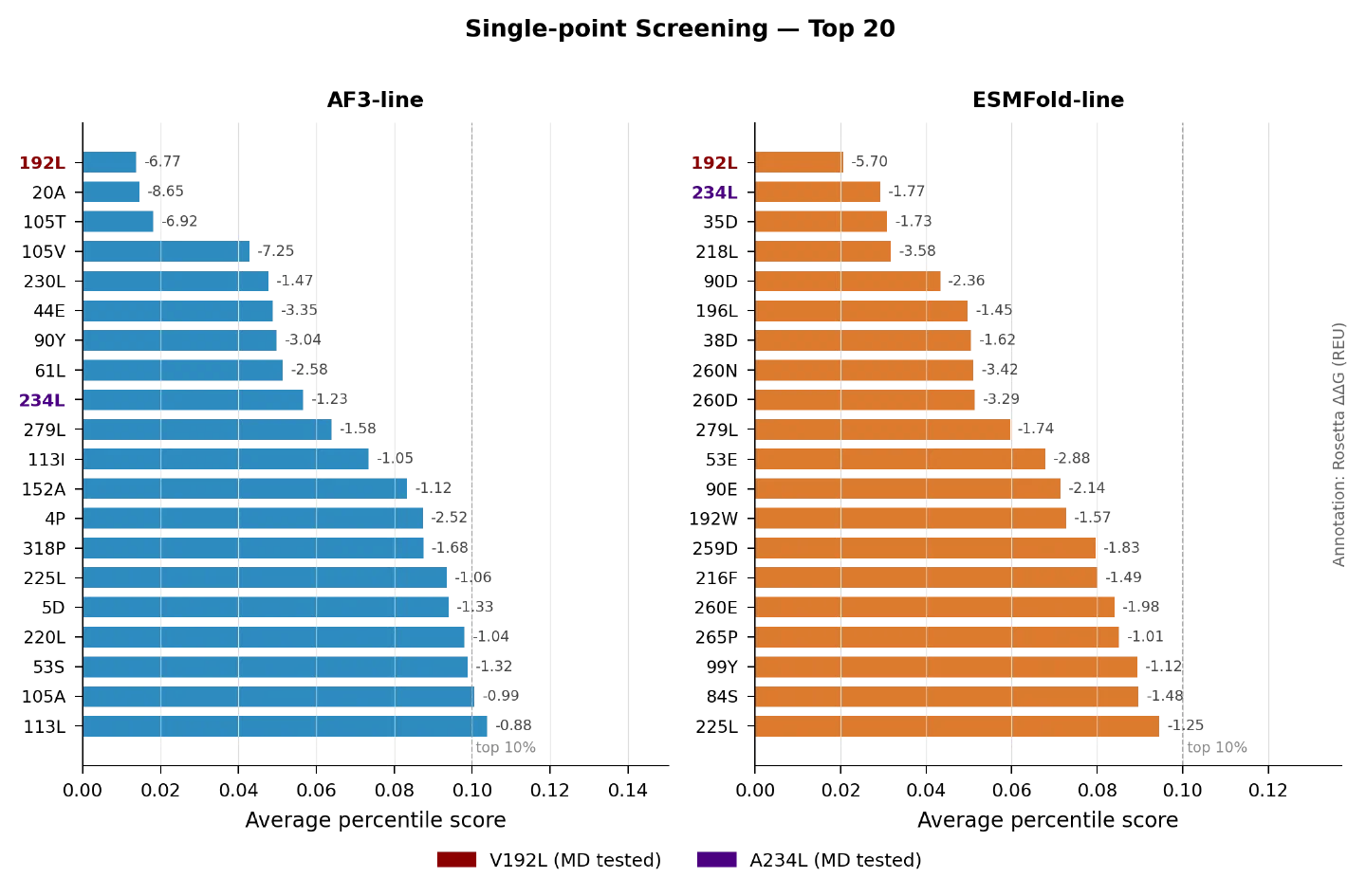
Two independent tracks. The whole pipeline was run twice, once from an AlphaFold3 model and once from an ESMFold model, and only mutations that reached the top 50 of both were treated as high-confidence. Fifteen did.
Each track ran the same stages: Rosetta FastRelax over 100 conformations, a single-point ΔΔG scan across 193 positions × 19 amino acids, a ThermoMPNN scan alongside it, and percentile cross-ranking to merge the two signals. Surviving single points were then enumerated into roughly 86,000 pairs and rescored.
Molecular dynamics. Candidates went into all-atom MD as full membrane systems — ~168,000 atoms in a mixed POPE/POPG bilayer with water and ions, CHARMM36m, GROMACS 2024.2 — for 12 × 500 ns, 6 µs of sampling in total.
Tools: Rosetta, GROMACS, ESM2, ThermoMPNN, AlphaFold3, PyMOL, HPLC.
Results
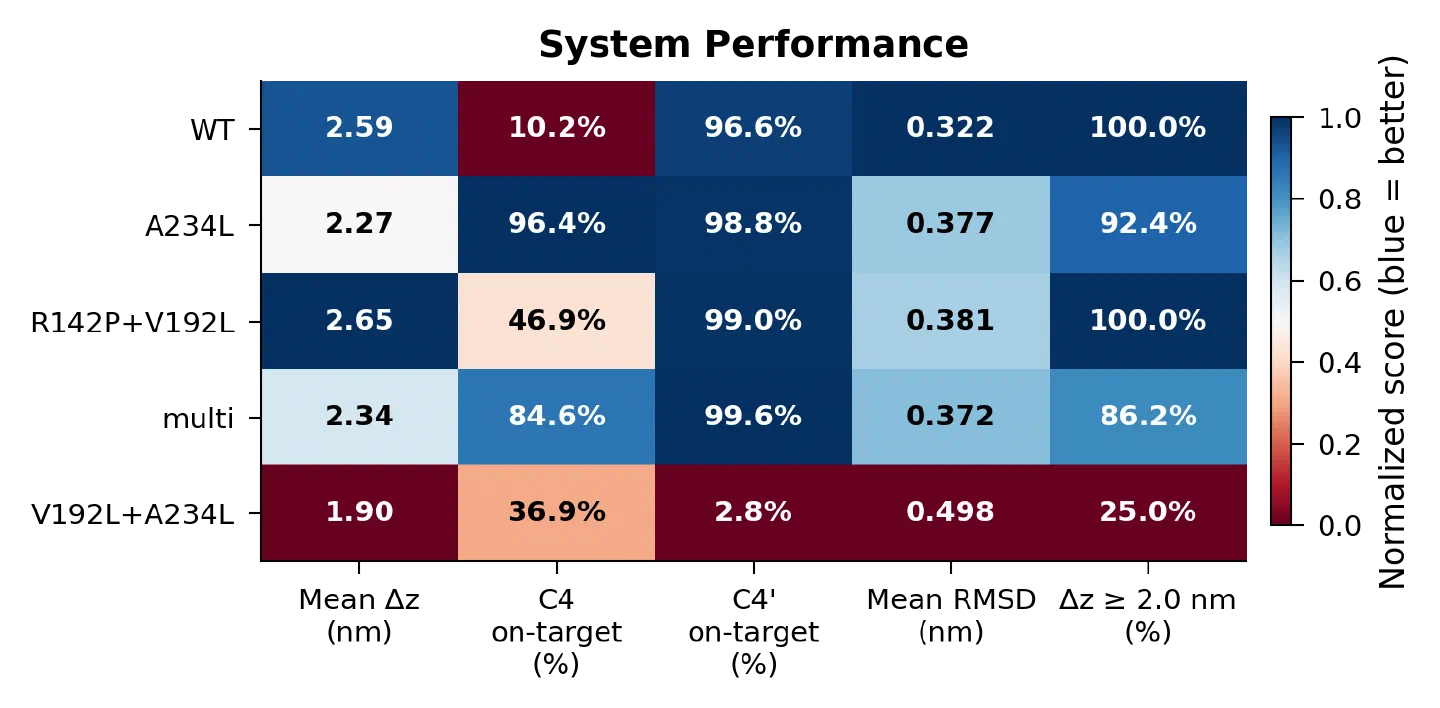
A234L is the design that works. In wild-type CrtW the C4′ end is well placed 96.6% of the time but C4 — the first ketolation site — reaches its target zone only 10.2% of the time, which is a structural account of why the enzyme is slow. The single mutation Ala234→Leu raises C4 to 96.4% while holding C4′ at 98.8%.
Carried into the wet lab, A234L confirmed the prediction in vitro at +46.7% yield over wild-type.
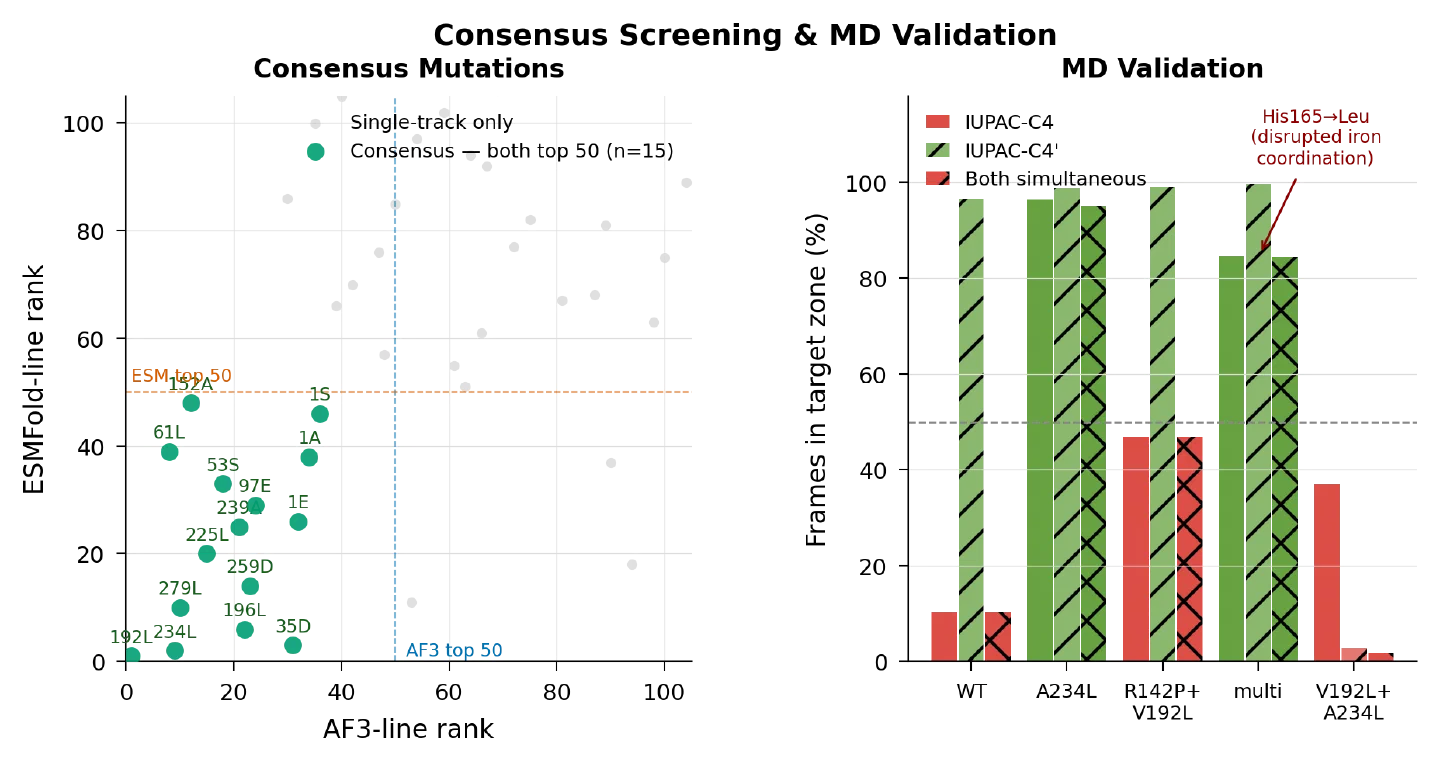
Requiring both ends to be on target at the same time separates the candidates sharply.
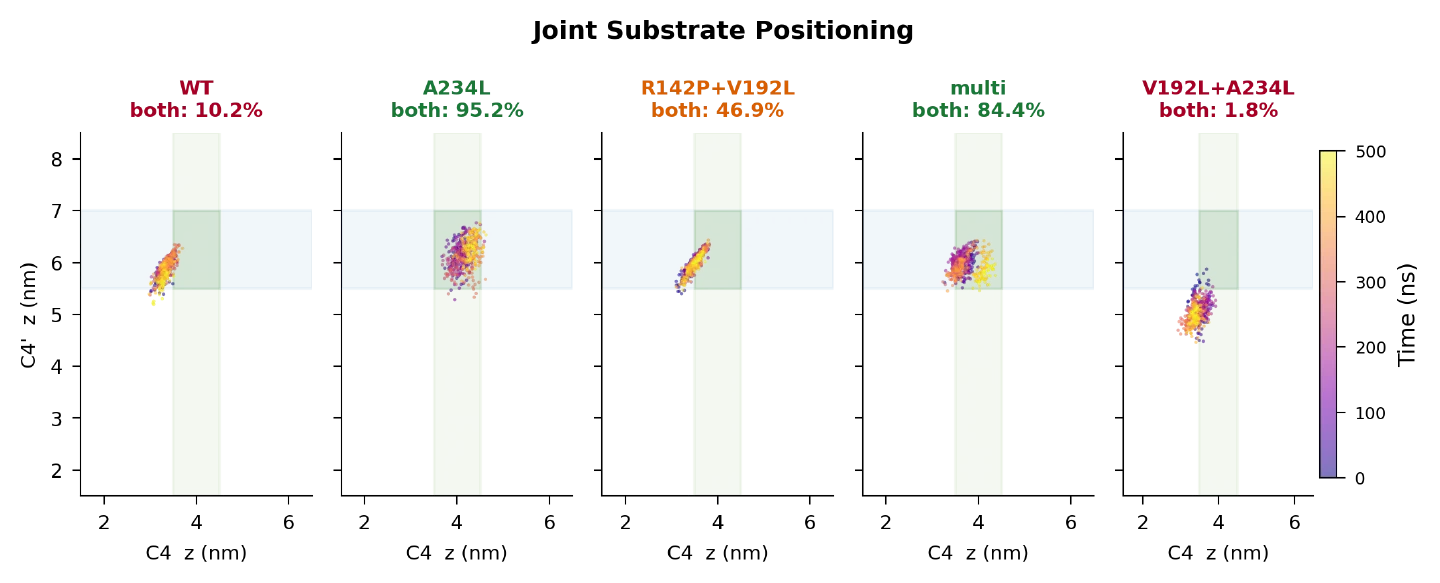
Two mutations that each work can fail together. V192L ranked first in both screening tracks and A234L was the best performer in MD, so the pair looked like the obvious combination. It collapsed: joint on-target occupancy fell to 1.8%, C4′ to 2.8%, and backbone RMSD was the highest of any system. Two leucines in the same pocket compress the space β-carotene needs to extend into, and the substrate curls. This is negative epistasis, and no amount of single-point ranking would have predicted it.
The catalytic centre itself is coordinated by seven histidines, and tracking their NE2 atoms against both ends of the substrate shows how the pocket is reorganised.
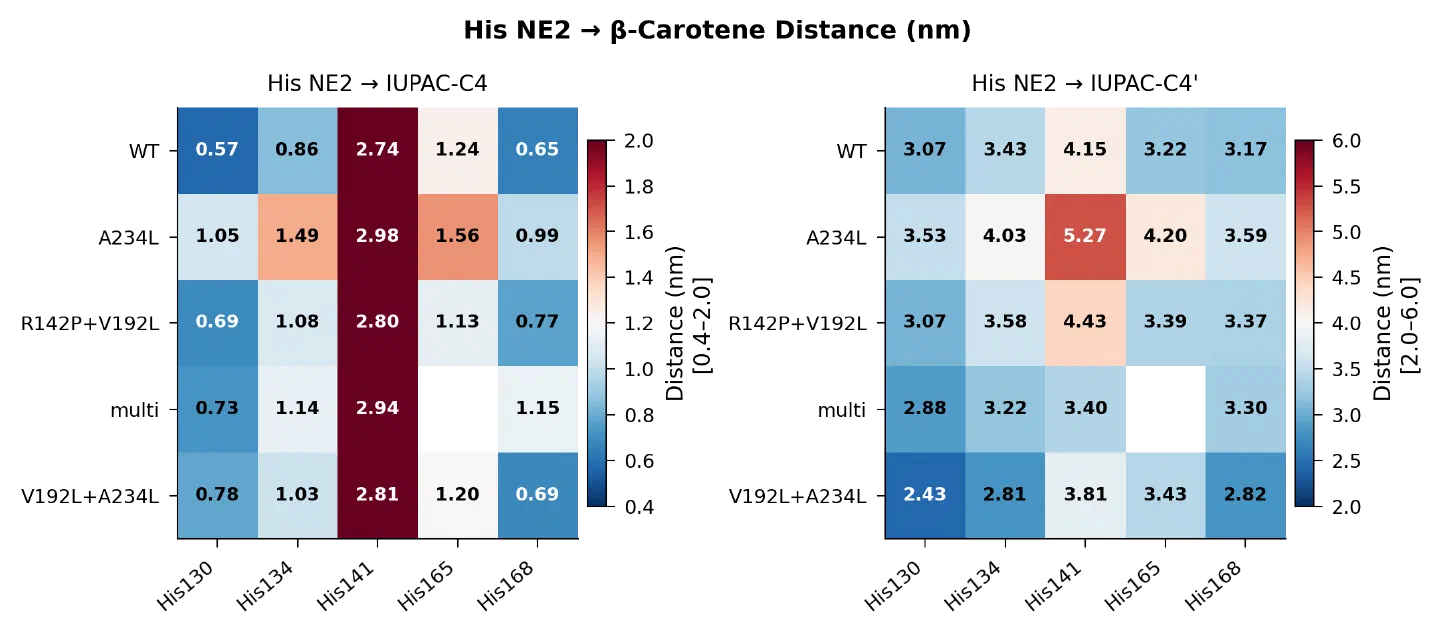
A separate lesson came from the 27-mutation FuncLib design, which scored well on substrate positioning but turned out to carry His165→Leu — a member of the HXXH iron-coordinating motif. Positioning says nothing about whether the metal centre survives; the screen needed the catalytic histidines locked before it ran, not after.
MD is what separated the design that worked from the one that looked strictly better on paper.
The project is ongoing.