Trimeric Redesign of a CAR-T Costimulatory Transmembrane Domain
Background
Chimeric antigen receptor (CAR) T cells rely on costimulatory domains to sustain activation, and 4-1BB is among the most widely used. In its native context the receptor assembles as a trimer, but conventional CAR constructs place its transmembrane domain (TMD) in an architecture that does not preserve that geometry.
Building on the host lab’s proCAR3 design hypothesis, this project asks a direct question: if the 4-1BBζ TMD is redesigned back into its natural trimeric form, does T cell activation improve?
Method
The work runs on two tracks.
Dry lab — computational screening. Four candidate designs went through four complementary routes: all-atom trimer simulations to test whether each assembly holds, umbrella sampling for the free energy of lateral assembly, coarse-grained runs started from separated helices to see whether they find each other unaided, and a separate insertion free energy for the single helix. Over 120 µs of GROMACS sampling in total, with Rosetta and ESM2 guiding and scoring the designs.
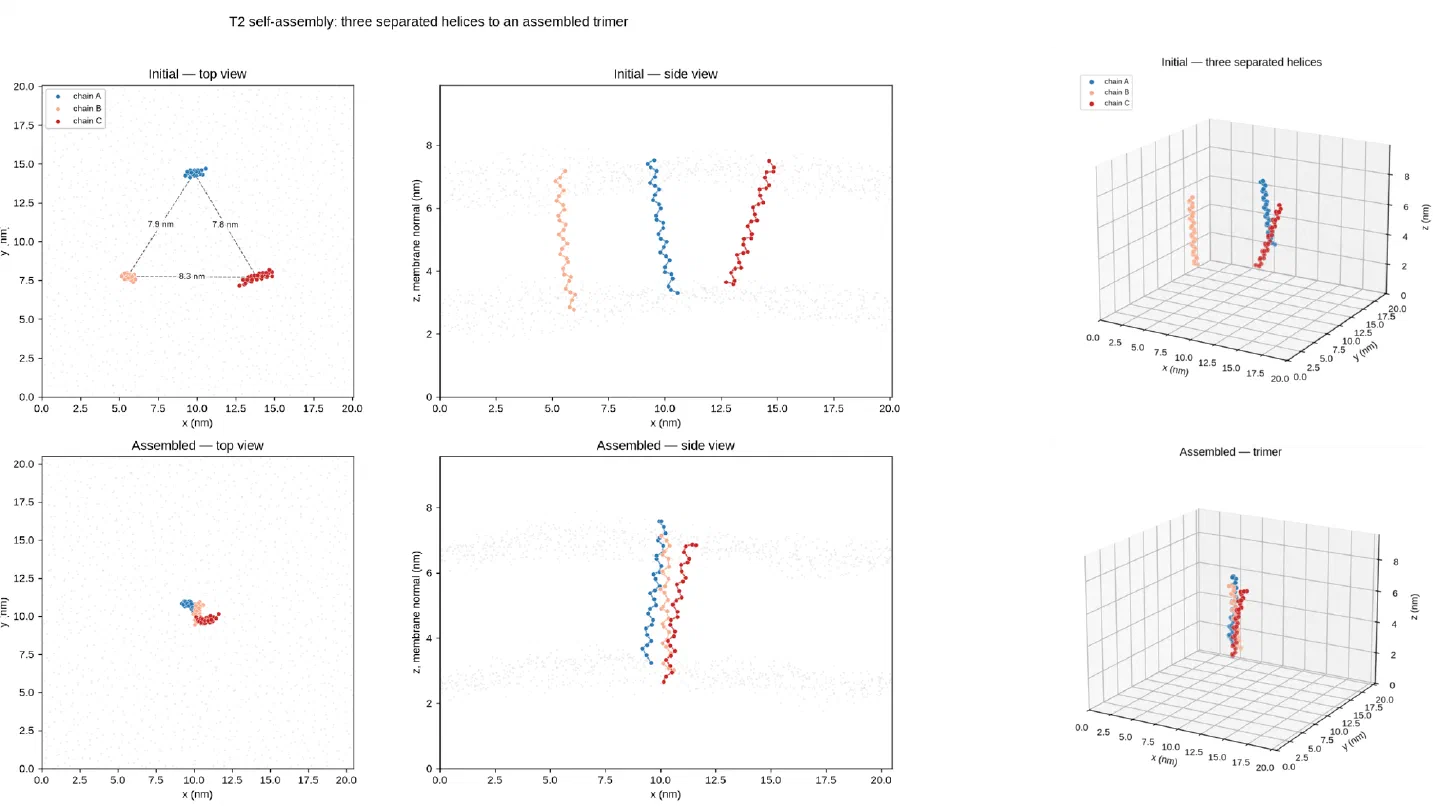
Most of that budget goes to the coarse-grained side. Asking whether three separated helices find each other at all means waiting for a rare event, which takes orders of magnitude longer than showing that an already-built trimer stays put.
Wet lab — functional validation. Collaborating with the team, I helped optimise 4 TMD variants, then ran flow cytometry and degranulation assays against 2 tumour cell lines, confirming surface expression before measuring function.
Techniques: flow cytometry, degranulation assay, HEK293T culture, GROMACS, ΔG prediction, Rosetta, ESM2.
Computational strategy
A single simulation cannot separate “the trimer never forms” from “it forms but the protein never reaches the surface”, so the question is split across four routes that answer different halves of it — assembly on one side, membrane insertion on the other.
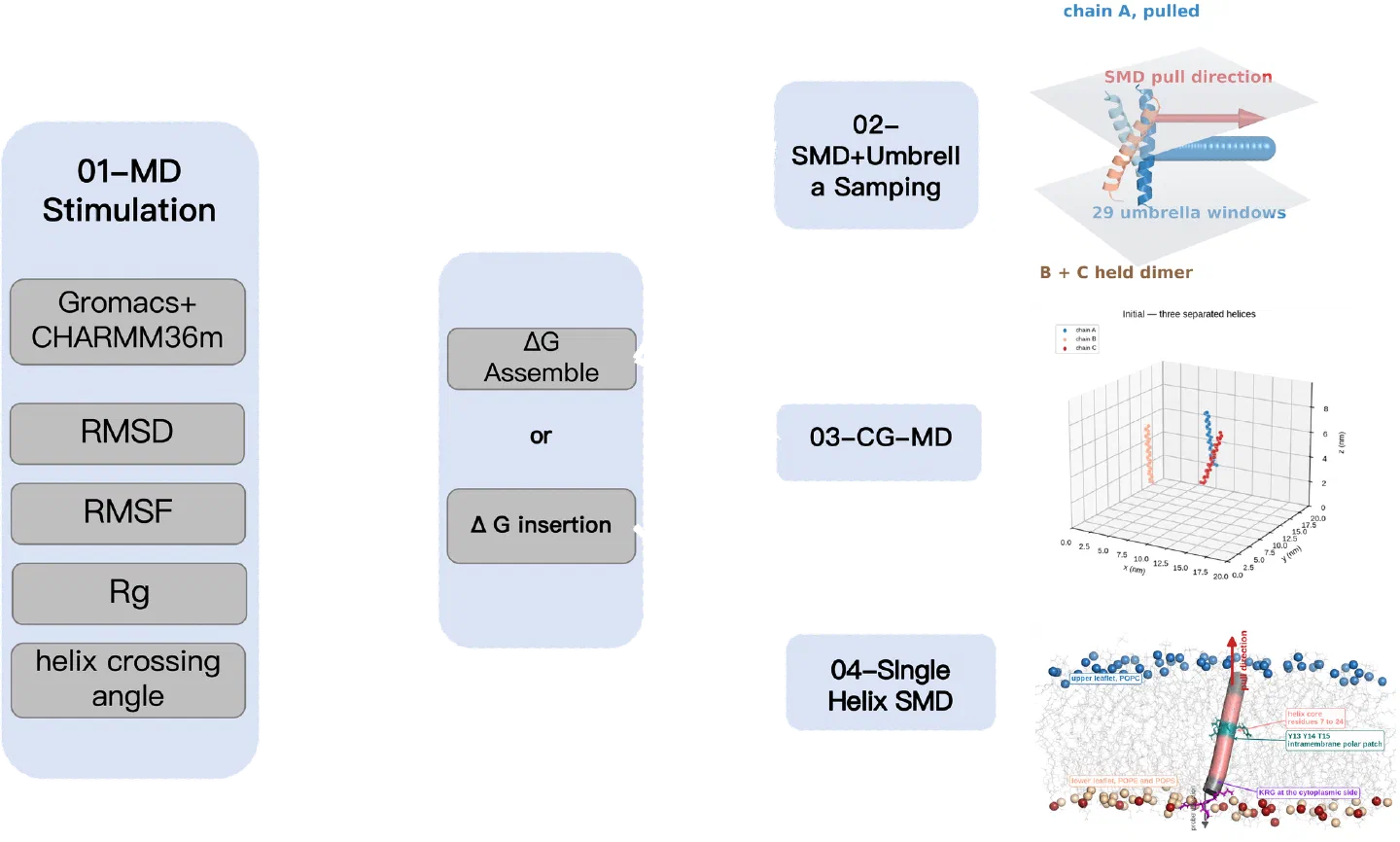
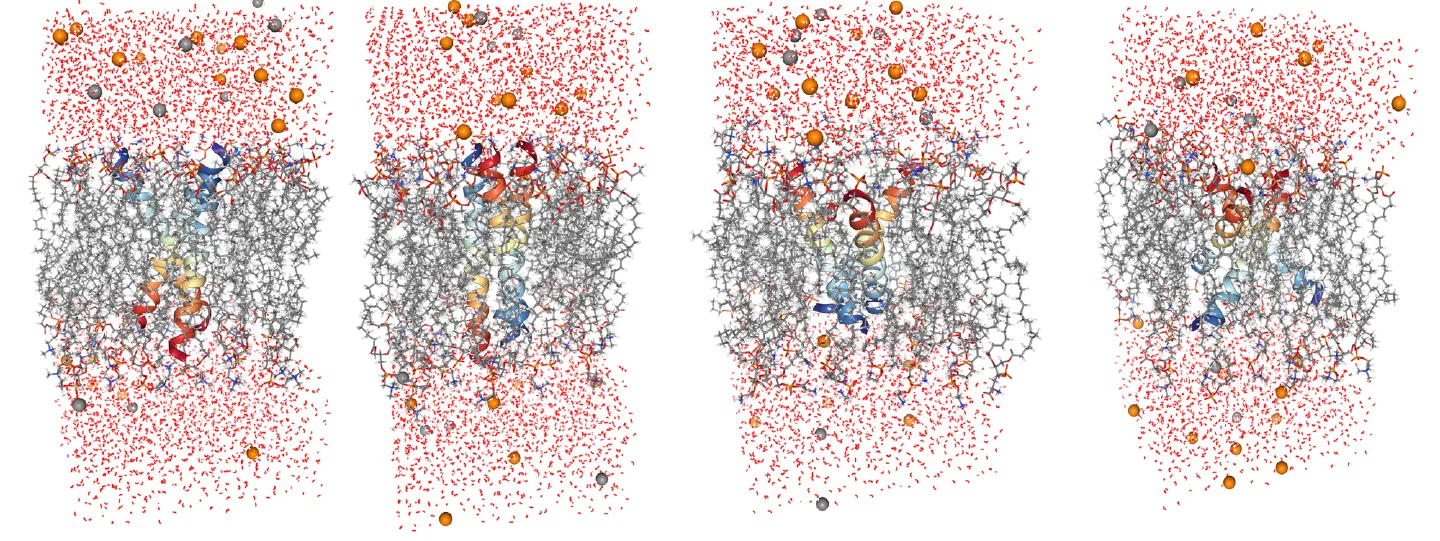
Each variant is built as a full membrane system — trimer, bilayer, water and ions — in CHARMM-GUI, then equilibrated in stages before production.
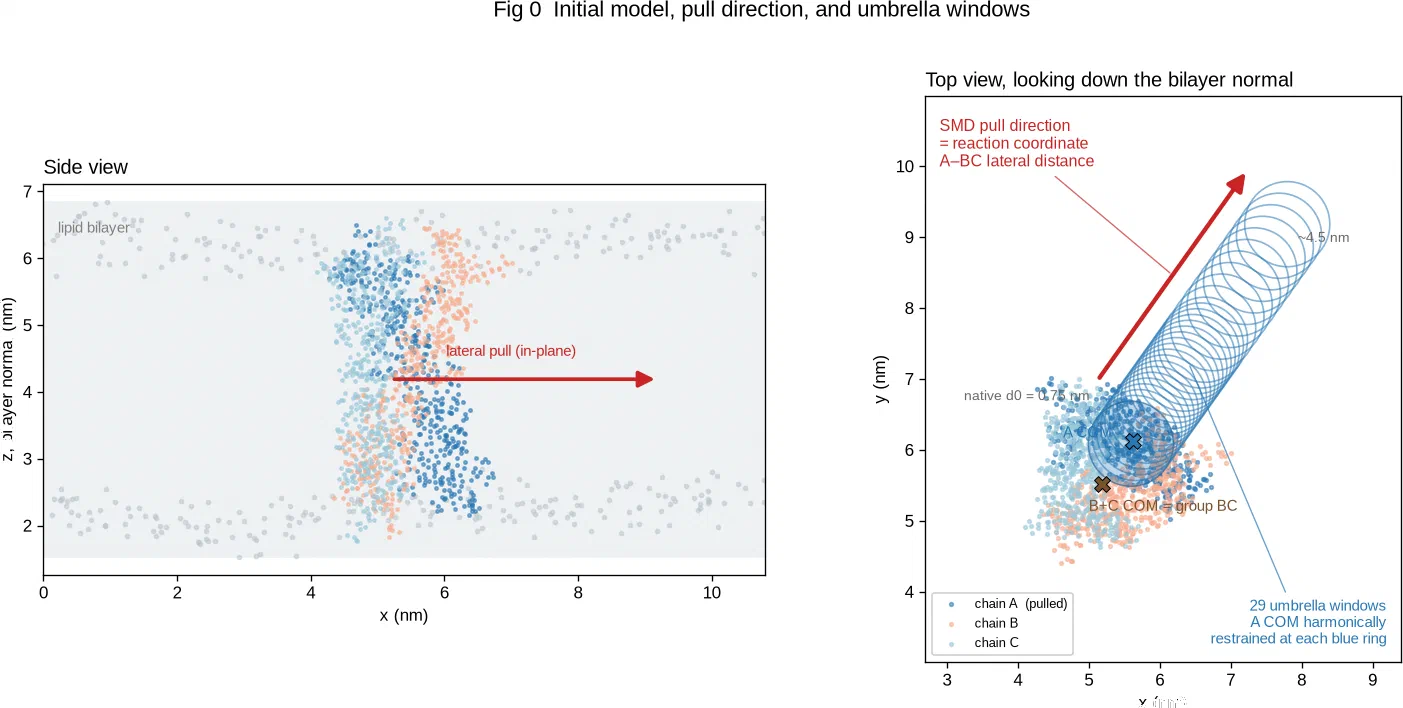
For the assembly free energy, one chain is pulled away from the other two in the plane of the membrane and the path is sampled with a series of umbrella windows.
A coarse-grained model runs the complementary experiment: start the three helices apart and see whether they find each other on their own.
Results
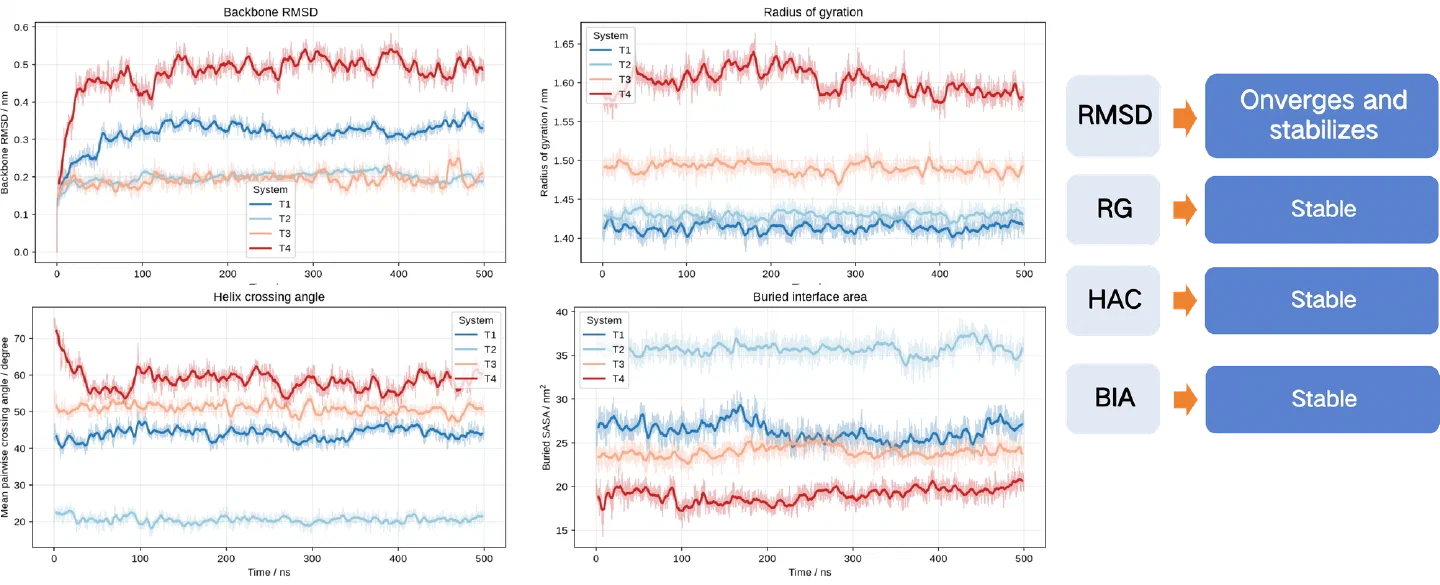
The designed trimers are real. All four all-atom trajectories converge and stay converged, and the interfaces hold rather than drifting apart over the run.
Contact between neighbouring chains is maintained at a high level throughout, and stays that way from the early window to the late one.
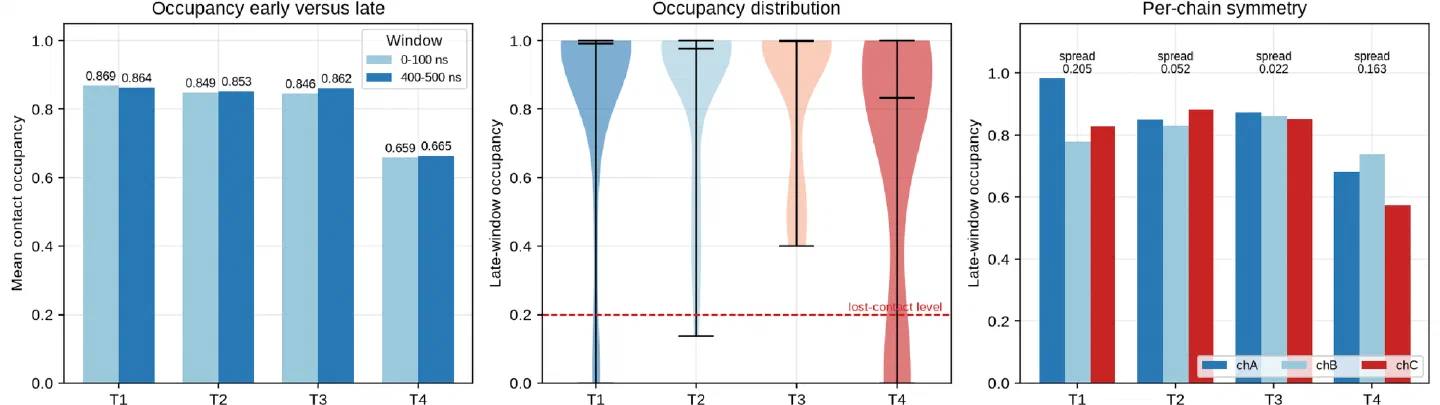
Together with the wet-lab result — 73–74% surface expression and T cell activation in the degranulation assay — this says the redesigned TMD both assembles and reaches the surface in working form.
The project is ongoing. The current focus is a functional comparison against the conventional 4-1BBζ architecture, and the free-energy work above is still being refined.
Fully funded through the InSPIRE program at the Walter and Eliza Hall Institute, the Department of Medical Biology of the University of Melbourne.